Guides · 8 min read
ECC RAM explained: UDIMM, RDIMM, LRDIMM and channels
Error correction, module types, ranks and memory channels: what to know before you buy or upgrade server memory.
Stock items leave our warehouse in Germany within 24 hours
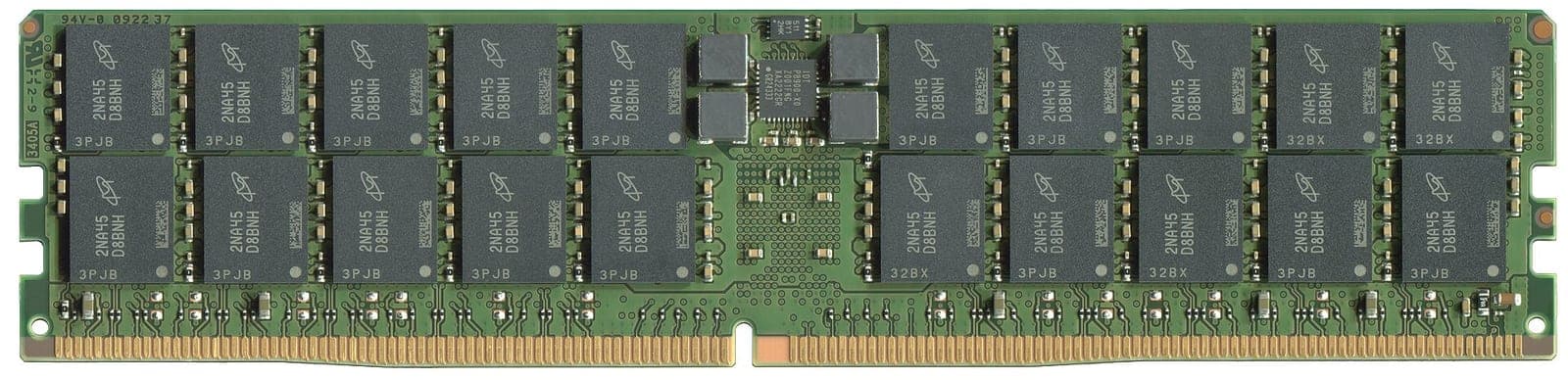
DDR5 ECC RAM is the memory standard of current server platforms: 4th and 5th Gen Intel Xeon Scalable, Xeon 6 and AMD EPYC 9004/9005 and 8004. Typical systems are the Dell PowerEdge R660 and R760, HPE ProLiant DL360 and DL380 Gen11 and Lenovo ThinkSystem SR630 V3 and SR650 V3. DDR5 modules do not physically fit DDR4 slots. Each module has its own voltage regulator (PMIC) and two independent sub-channels; in addition to ECC protection across the memory bus, the chips use on-die ECC. For full bandwidth, populate all channels identically: EPYC 9004 has twelve channels, Xeon Sapphire Rapids eight per processor. We supply registered modules (RDIMM) from 4800 to 6400 MT/s, new or used, tested and with 12 to 36 months warranty. Businesses can buy on invoice.
No products found
Adjust the filters or ask us directly. We can source most hardware within a few days.
DDR5 ECC RAM isn't something you choose – it follows from the platform. Servers with 4th Gen Intel Xeon Scalable onwards or AMD EPYC 9004 onwards only work with DDR5 RDIMMs. Every older system stays on DDR4 ECC RAM. Below you'll find how many channels and what speed each platform uses, and how to populate DDR5 sensibly.
| Platform | CPU socket | Channels per CPU | Speed (1 module per channel) | Example servers |
|---|---|---|---|---|
| 4th Gen Xeon Scalable (Sapphire Rapids) | LGA4677 | 8 | 4800 MT/s | Dell R660/R760, HPE DL360/DL380 Gen11, Lenovo SR630 V3/SR650 V3 |
| 5th Gen Xeon Scalable (Emerald Rapids) | LGA4677 | 8 | 5600 MT/s | the same servers with a suitable BIOS |
| AMD EPYC 9004 (Genoa) | SP5 | 12 | 4800 MT/s | Dell R6625/R7625, HPE DL365/DL385 Gen11, Lenovo SR645 V3/SR665 V3 |
| AMD EPYC 9005 (Turin) | SP5 | 12 | up to 6000 MT/s | SP5 servers with a supporting BIOS |
Answers to the questions we hear most often before a first order.
Question not listed?
Bandwidth rises considerably. A DDR5-4800 channel delivers 38.4 GB/s in theory, a DDR4-3200 channel 25.6 GB/s. A fully populated EPYC 9004 therefore reaches about 460 GB/s per socket, a 4th Gen Xeon about 307 GB/s. Databases, HPC workloads and hosts with very high core counts benefit most.
Both module types have 288 pins, but the notch is in a different place, so a DDR5 module won't go into a DDR4 slot or vice versa. Behind that lie real electrical differences:
In practice, moving platforms – say from a Dell R740 to an R760 – always means new memory. You can sell your old DDR4 modules through our buy-back service and receive an offer within 48 hours.
As with DDR4, every channel should be populated the same way: 8 or 16 modules per CPU on Xeon, 12 or 24 on EPYC 9004. Typical configurations per socket:
Why DDR5 servers still need true ECC modules despite on-die ECC is explained in our guide ECC RAM: UDIMM, RDIMM and LRDIMM. All memory types are listed under server RAM; businesses can buy on invoice – see our page for business customers.
No. Servers with Xeon Scalable or EPYC require registered DDR5 RDIMMs. Unbuffered DDR5 ECC UDIMMs are only intended for workstation and entry-level platforms such as Intel Xeon E-2400 or AMD EPYC 4004.
Speed depends on CPU and population: Sapphire Rapids supports up to 4800 MT/s, Emerald Rapids up to 5600 MT/s, EPYC 9004 up to 4800 MT/s. Faster modules run fine at a lower speed and can be reused on later platforms.
Guides · 8 min read
Error correction, module types, ranks and memory channels: what to know before you buy or upgrade server memory.