Guides · 8 min read
Buying used servers: what really matters
Generation, form factor, CPU, memory, controller, remote management and warranty: the points that decide whether a used server fits your workload.
Stock items leave our warehouse in Germany within 24 hours
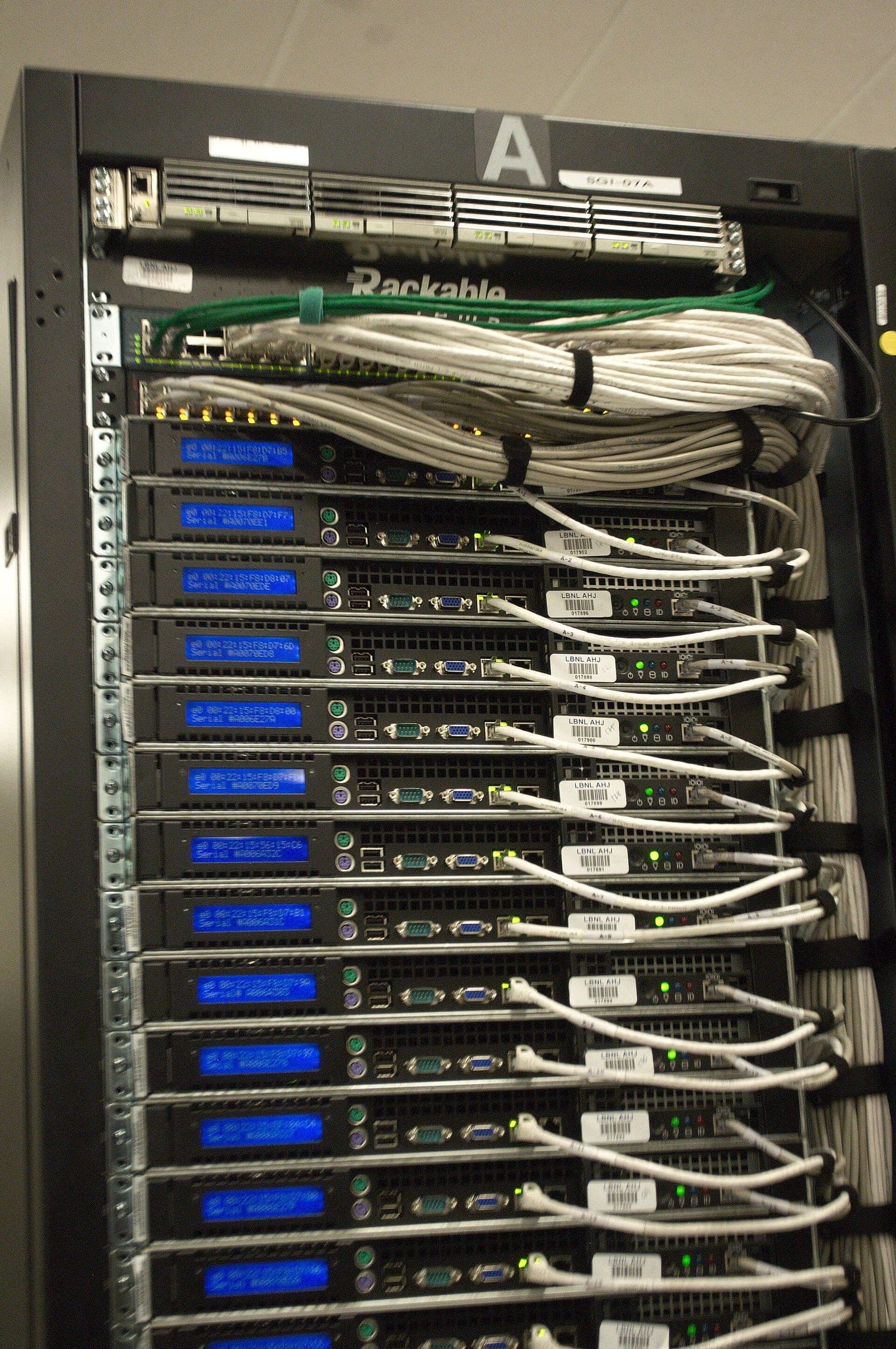
Rack servers in 19-inch format are the standard form factor for server cabinets and data centers. 1U models such as the Dell PowerEdge R640 or HPE ProLiant DL360 Gen10 save rack units, while 2U models such as the R740 or DL380 Gen10 offer more drive bays, PCIe slots and room for GPUs. We supply refurbished rack servers with your choice of processors, RAM, SSDs or hard drives, RAID controller or HBA, network cards, redundant power supplies and matching rails. Before ordering, check the usable depth of your cabinet (many models are 70 to 80 cm deep), the available power and the location: rack servers are built for server rooms, not offices. Every system is cleaned, updated to current firmware, checked and tested. Warranty is 12 to 36 months; businesses can buy on invoice.
No products found
Adjust the filters or ask us directly. We can source most hardware within a few days.
A rack server is a 19-inch server built to be mounted in a server cabinet. Whether a 1U or a 2U machine suits you better comes down to drives, expansion cards, cooling and noise. Below you'll find the practical differences, the platforms in our range and which model fits which job.
e.g. Dell R640, HPE DL360 Gen10, Lenovo SR630
Answers to the questions we hear most often before a first order.
Question not listed?
Best for: Ideal for web servers, firewalls, cluster nodes and hosts with shared storage.
e.g. Dell R740, HPE DL380 Gen10, Lenovo SR650
Best for: Ideal for virtualisation hosts, databases, local storage and GPU upgrades.
| Platform | 1U | 2U | Key points |
|---|---|---|---|
| Xeon E-2200, single socket | Dell R340 | – | max. 64 GB ECC UDIMM, 4× 3.5-inch, frugal |
| Xeon E5 v4 (Dell 13G, HPE Gen9) | Dell R630 | Dell R730, HPE DL380 Gen9 | up to 2× 22 cores, DDR4-2400, PCIe 3.0 |
| 1st/2nd gen Xeon Scalable (Dell 14G, HPE Gen10, Lenovo) | Dell R640, HPE DL360 Gen10, Lenovo SR630 | Dell R740 and R740xd, HPE DL380 Gen10, Lenovo SR650 | up to 2× 28 cores, 6 memory channels per CPU, Optane PMem 100 |
| 3rd gen Xeon Scalable (Dell 15G) | – | Dell R750 | up to 2× 40 cores, 8 memory channels, PCIe 4.0 |
| AMD EPYC 7002 (HPE Gen10 Plus) | – | HPE DL385 Gen10 Plus | up to 2× 64 cores, 8 memory channels, PCIe 4.0 |
For new projects, the 14G and Gen10 generation is usually the best balance of price, performance and firmware support. The Dell R730 is the cheapest way into dual-socket, while the PCIe 4.0 systems pay off with lots of NVMe drives and 25 or 100 GbE networking.
Rack servers need a four-post rack, as the sliding rails hook in at the front and back. A 2U server weighs around 25 kg, so mount it with two people and put heavy kit at the bottom. Air flows front to back; fill empty rack units with blanking panels so warm exhaust isn't drawn back round to the front.
Redundant power supplies only protect you if they're on two separate circuits. A typical virtualisation host is fine with 750 W; with GPUs or lots of drives, 1100 to 1600 W makes sense. Rack units, cabinet depth and mounting are covered step by step in our 19-inch rack guide.
Width is standardised, depth is not. Many 1U and 2U servers are 70 to 80 cm deep, plus room for cables and rails. For shallow wall-mount cabinets, a short-depth model or a tower server is the better choice.
Sliding rails extend so the server can be opened while it stays mounted. Static rails are cheaper, but the server has to be removed for maintenance. You can select the matching OEM rails directly in the configurator.
Fan speed follows temperature and load. Current generations such as Dell 14G or HPE Gen10 are much quieter at idle than older systems, but they are not designed to sit next to a desk. Third-party PCIe cards can raise fan speeds.
Guides · 8 min read
Generation, form factor, CPU, memory, controller, remote management and warranty: the points that decide whether a used server fits your workload.