19-inch rack: rack units, depth and server cabinets
What 19 inches and a rack unit actually mean, how deep a server cabinet needs to be and how to fill a small rack with servers, a switch and a UPS.
- Published
- Reading time
- 8 min
- Topic
- Rack, remote management & virtualisation
Contents9 sections
- What does 19 inch mean?
- Rack units: 1U = 44.45 mm
- Rack height, width and rack depth
- Server cabinet, network cabinet or open rack?
- Mounting: hole pattern, rails and cable management
- Distributing weight and airflow
- Power: PDUs and redundant power supplies
- Planning example: a small rack with two servers
- Frequently asked questions
Key points
- 19 inches is a 482.6 mm front panel, 1U is 44.45 mm. A 42U cabinet stands about 2 m tall.
- Rack servers need 1,000 to 1,200 mm of depth and a four-post rack with sliding rails.
- Heavy kit at the bottom, gaps closed with blanking panels, air flowing front to back.
- Redundant power supplies only work on separate circuits – PDU A and PDU B.
A 19-inch rack is the standard that servers, switches, patch panels and UPS units from every vendor fit into. Width is standardised and height is counted in rack units; what really matters is depth, load rating, cooling and power. This guide explains the dimensions and shows how to fill a small rack with rack servers.
What does 19 inch mean?
19 inches is the width of a device's front panel including its mounting ears: 482.6 mm. Between the vertical rails there is at least 450 mm of clear width for the chassis, and the holes on the left and right are 465 mm apart. These dimensions and the hole pattern are standardised; depth, cabinet width and hole shape vary by vendor.
Rack units: 1U = 44.45 mm
Height is measured in rack units, written U. One U equals 1.75 inches or 44.45 mm. Each U has three holes per side, spaced 15.9, 15.9 and 12.7 mm apart – the shorter gap marks the boundary to the next unit.
| Height | Millimetres | Typical equipment |
|---|---|---|
| 1U | 44.45 mm | patch panel, switch, Dell PowerEdge R640, HPE DL360 Gen10 |
| 2U | 88.9 mm | Dell R740, HPE DL380 Gen10, Lenovo SR650, small UPS |
| 4U | 177.8 mm | storage servers with 36 bays, GPU servers with 8 GPUs |
| 42U | 1,866.9 mm | mounting height of a standard cabinet |
Rack height, width and rack depth
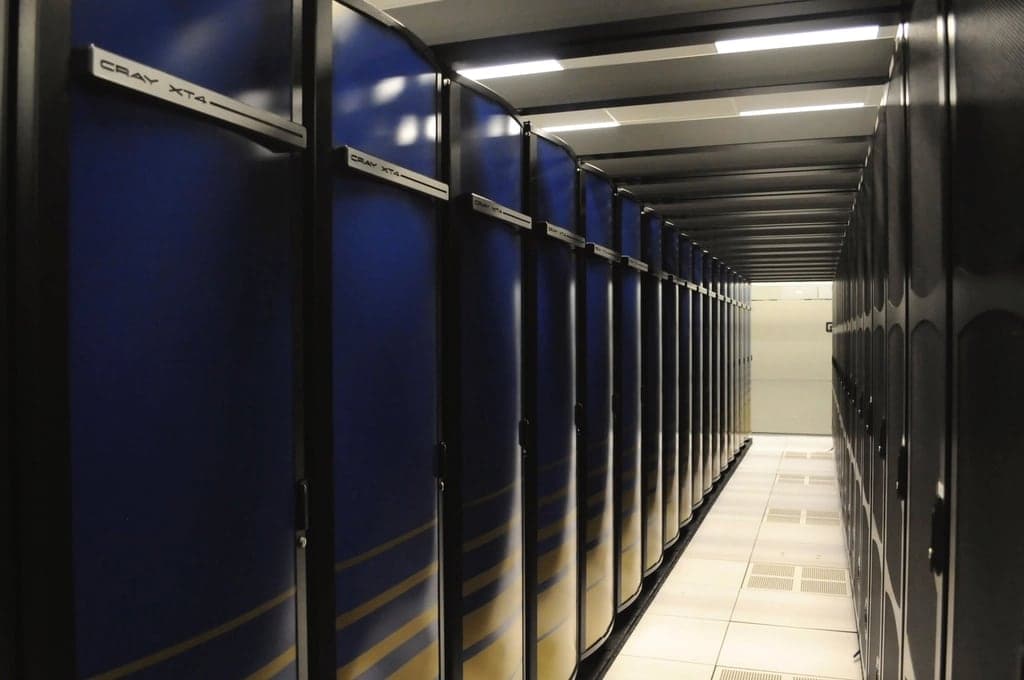
Common heights are 24U, 42U and 47U. A 24U cabinet is about 1.2 m tall and suits offices and small comms rooms. 42U means roughly 2 m outside and is the data centre standard. 47U cabinets reach about 2.2 m and often won't pass upright through a door.
Width: 600 or 800 mm
600 mm matches a raised-floor tile and suits pure server racks. 800 mm leaves about 100 mm per side for vertical cable management and 0U power strips – better for lots of patch cables.
Rack depth: why servers need 1,000 to 1,200 mm
Typical depths are 600, 800, 1,000 and 1,200 mm. A 2U server such as the Dell PowerEdge R740 is around 70 cm deep, and behind it you need room for power cords, a cable management arm and exhaust air. Below 1,000 mm it gets tight; 1,200 mm is comfortable and suits deeper GPU and storage servers. 600 and 800 mm cabinets are for switches and patch panels.
Server cabinet, network cabinet or open rack?
A two-post rack has just two uprights and carries patch panels and switches hanging from their front ears. Servers of 25 kg or more belong in a four-post rack, with rails fixed front and back. Open four-post frames are cheap and accessible, but neither lockable nor dust-proof.
A network cabinet is usually 600 to 800 mm deep, often has a glass door and carries a few hundred kilograms. A server cabinet is 1,000 to 1,200 mm deep, has perforated front and rear doors and is built for far more weight, often 1,000 kg or more. Glass doors block airflow and don't suit servers.
Mounting: hole pattern, rails and cable management
Server cabinets almost always have 9.5 mm square holes, into which you fit cage nuts (usually M6) for equipment without rails. Some uprights have round holes, threaded or unthreaded. Most tool-less server rails fit square and unthreaded round holes; threaded holes need adapters or other rails.
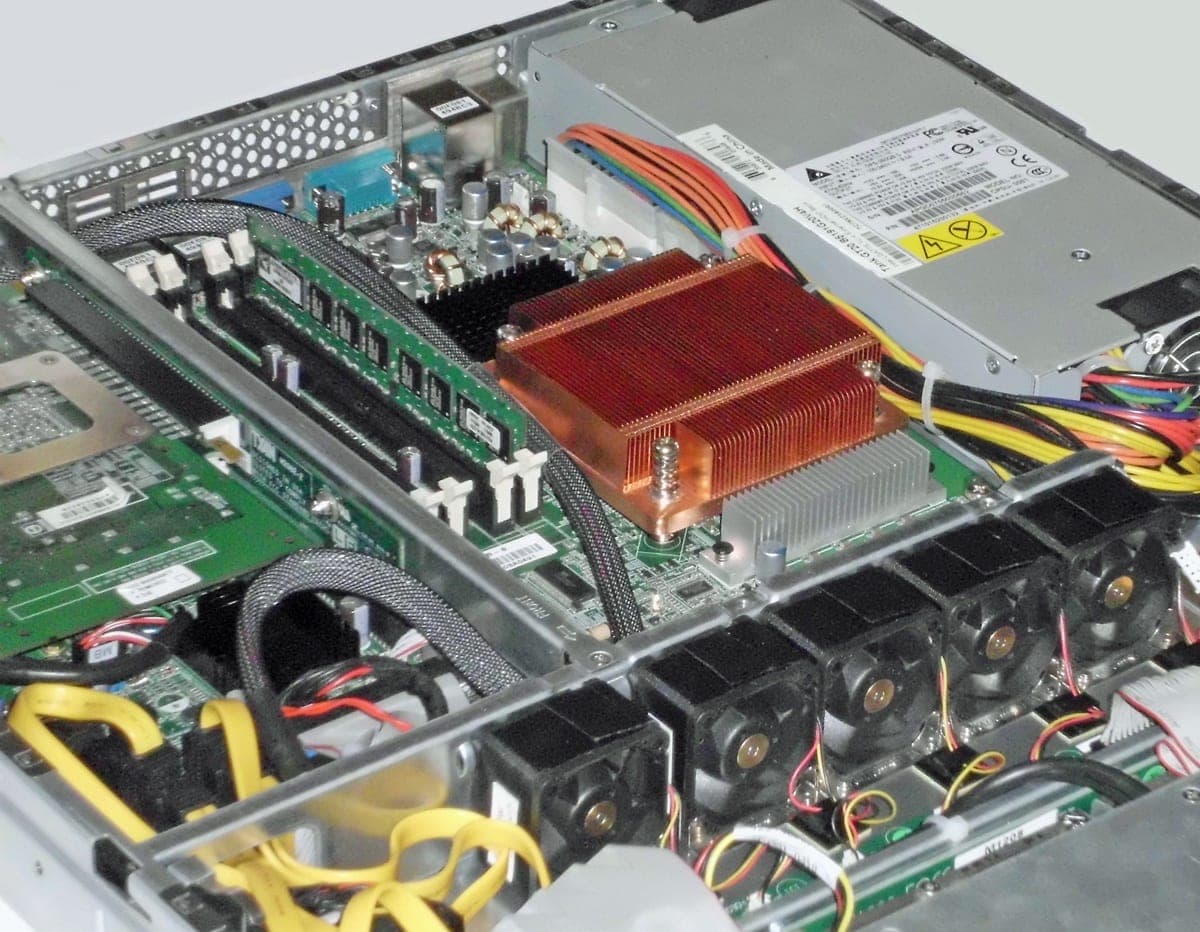
Sliding rails let you pull a server out like a drawer to swap memory, drives or fans in place. Static rails are cheaper, but the server must come out completely for any maintenance. A cable management arm carries the cables as the server slides out, but costs depth and hinders airflow in a full rack; cables with a little slack often work just as well.
Mounting a server on rails
Choose the position
Count units from the bottom and mark where the rail starts. Heavy servers go low.Hang the outer rails
Hook in the rear, then the front, until the latch clicks. Both rails must sit at the same unit.Extend the rails
Pull both rails out until they lock. On some systems, inner rails clip onto the chassis first.Lift the server in
From about 20 kg, work in pairs. Lower the server's side pins into the rail slots and check every pin is seated.Slide in and lock
Release the rail locks and push the server in until the front latches engage.Cable up and test
PSU 1 to PDU A, PSU 2 to PDU B. Pull the server out fully once to check no cable is under strain.
Distributing weight and airflow
Heavy equipment goes at the bottom: UPS and battery packs lowest, then 2U and storage servers, with light switches and patch panels on top. A low centre of gravity stops the cabinet tipping when a server is pulled out. Never extend more than one device at a time, and stand the cabinet on its levelling feet, not its castors.
Servers draw cool air in at the front and exhaust it at the back. Every open unit lets warm air flow back to the front, so close gaps with blanking panels. With cabinets in rows, fronts face the cold aisle and backs the hot aisle. Switches with rear-facing ports need reversed airflow, so many models come in two fan variants.
Power: PDUs and redundant power supplies
Use proper rack PDUs, not DIY-store power strips. Servers have IEC C13/C14 connectors rated up to 10 A; high-power devices and UPS units sometimes use C19/C20 up to 16 A. The PDU plugs into an industrial CEE or a Schuko socket. Basic PDUs just distribute power, metered ones show the load, switched ones turn outlets on and off remotely.
Two power supplies are only redundant if they sit on separate circuits: PSU 1 on PDU A, PSU 2 on PDU B. Each circuit must carry the entire load alone. A 16 A circuit at 230 V delivers 3,680 W on paper – stay well below that.
Planning example: a small rack with two servers
A typical office setup: two 2U servers, a switch, a patch panel and a UPS – 9U in total. A 24U server cabinet of 800 × 1,000 mm will do if little growth is expected; 42U gives long-term headroom.
| Unit | Equipment | Approx. weight |
|---|---|---|
| 24 | patch panel, 24 ports | 1 kg |
| 23 | cable management panel | 1 kg |
| 22 | switch with 10 GbE uplinks | 5 kg |
| 9–21 | spare, closed with blanking panels | – |
| 7–8 | server 2: HPE ProLiant DL380 Gen10 | 25 kg |
| 5–6 | server 1: Dell PowerEdge R740 | 28 kg |
| 3–4 | spare for a battery pack | – |
| 1–2 | UPS with batteries | 30 kg |
Assuming a total load of 600 W, a UPS of around 1,500 VA is enough to shut the servers down cleanly in a power cut. PSU 1 of each server goes to the UPS, PSU 2 to a second circuit.
For a homelab, one 1U server in a small cabinet often does – expect audible fans. Old tower servers freed up by the move to a rack can be offered to us through our server buy-back.
Frequently asked questions
Short answers to the questions we hear most often on this topic.
How many mm is one rack unit?
One rack unit (U) is 1.75 inches, or 44.45 mm. A 2U server is therefore 88.9 mm tall, and a 42U cabinet offers 1,866.9 mm of mounting height.
How deep does a server rack need to be?
At least 1,000 mm, ideally 1,200 mm. The servers are around 70 to 80 cm deep, plus room for cables and exhaust air.
How wide is a 19-inch rack?
Front panels are 482.6 mm wide. The cabinet itself is usually 600 or 800 mm wide; 800 mm leaves side room for cables and PDUs.
What is the difference between a network cabinet and a server cabinet?
Network cabinets are shallower, often have a glass door and carry less. Server cabinets are 1,000 to 1,200 mm deep, have perforated doors for airflow and carry far more weight.
How tall is a 42U rack?
About 2 m externally, a little more with plinth and roof. 47U cabinets stand around 2.2 m and often won't pass upright through a normal door.
Keep reading
IPMI, iDRAC and iLO: server remote management explained
Virtual console, ISO mounting, sensors, firmware updates: what the management controllers from Dell, HPE, Lenovo and Supermicro can do and how to run them safely.
Read more
Proxmox server as a VMware alternative: hardware, migration
What Proxmox VE can do, how it differs from VMware, what hardware a Proxmox server needs and how to move your VMs across.
Read more
Buying used servers: what really matters
Generation, form factor, CPU, memory, controller, remote management and warranty: the points that decide whether a used server fits your workload.
Read more