Guides · 8 min read
RAID 10, RAID 5 or RAID 6? RAID levels compared
From RAID 0 to RAID 60: what each level gives you in capacity, safety and write speed, why large hard drives need RAID 6 and when an HBA is the better fit.
Stock items leave our warehouse in Germany within 24 hours
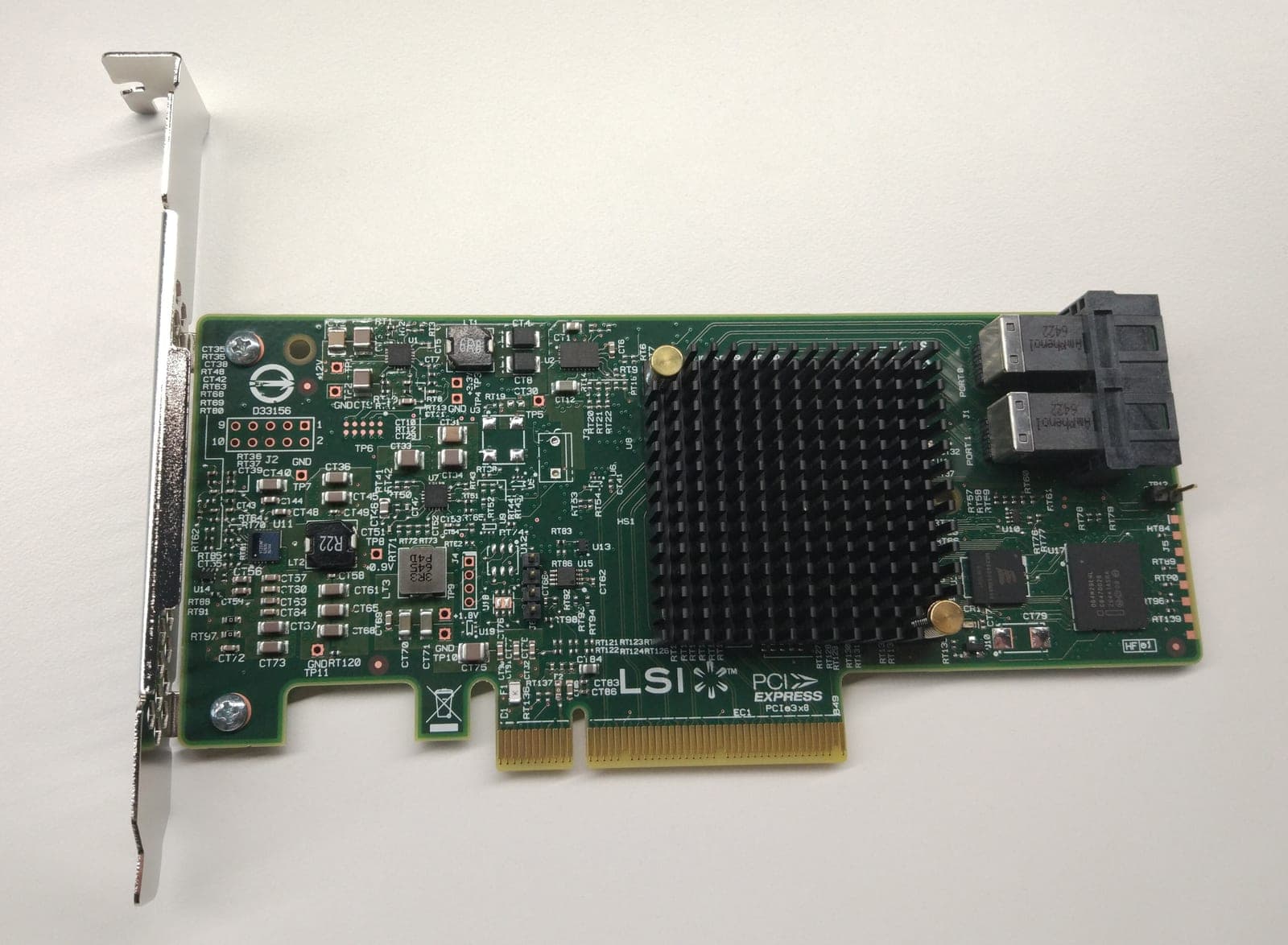
RAID controllers and HBAs connect SAS and SATA drives to the server and determine who takes care of redundancy. A hardware RAID controller such as the Dell PERC H730P or H740P, HPE Smart Array P408i or Broadcom MegaRAID 9361 builds RAID 1, 5, 6 or 10 with its own cache and battery or capacitor module and suits Windows Server, VMware ESXi and Hyper-V. For ZFS, TrueNAS, Unraid or Ceph, on the other hand, you need an HBA or a controller in IT mode, such as a Dell HBA330, Broadcom 9300-8i or 9400-16i, so the operating system sees every disk directly. Check the form factor: Dell mini mono and HPE AROC controllers only fit their respective servers, while PCIe cards work anywhere. NVMe drives require a tri-mode controller. Every controller is tested and shipped with current firmware; warranty is 12 to 36 months.
No products found
Adjust the filters or ask us directly. We can source most hardware within a few days.
A RAID controller decides who manages drive redundancy in a server: the controller itself or the operating system. The choice depends less on the hardware than on the software you plan to run. The overview below places each controller in our range and shows what to look for when buying used.
e.g. PERC H730P, Smart Array P408i-a
Answers to the questions we hear most often before a first order.
Question not listed?
Best for: Ideal for Windows Server, Hyper-V and VMware ESXi with local storage.
e.g. HBA330, LSI 9300-8i, 9400-8i
Best for: Ideal for TrueNAS, Proxmox with ZFS, Unraid and Ceph nodes.
| Model | Mode | Cache | Form factor | Fits |
|---|---|---|---|---|
| Dell PERC H730P | RAID 0/1/5/6/10/50/60, HBA mode | 2 GB NV cache with battery | PCIe card, 2× SFF-8643 | Dell PowerEdge 13G/14G |
| HPE Smart Array P408i-a | RAID 0/1/5/6/10/50/60, mixed mode | 2 GB FBWC | AROC module, 2× SFF-8643 | ProLiant Gen10 with AROC slot |
| Dell HBA330 | HBA, no RAID | – | PCIe card, 2× SFF-8643 | Dell 13G/14G, other PCIe servers |
| LSI 9300-8i | HBA, IT firmware | – | PCIe card, 2× SFF-8643 | any server with a PCIe x8 slot |
| Broadcom 9400-8i | tri-mode HBA (SAS, SATA, NVMe) | – | PCIe card, 2× SFF-8643 | any server with a PCIe x8 slot |
With HPE, the suffix gives away the form factor: -a means the AROC module in its own motherboard slot, -p a standard PCIe card. A P408i-a therefore only fits ProLiant servers with that slot.
All three pass drives straight to the operating system without a RAID layer. The LSI 9300-8i is the popular classic for TrueNAS and Proxmox, with drivers in Linux and FreeBSD. The Dell HBA330 uses the same chip but is managed through iDRAC and updated with Dell firmware in PowerEdge servers – the clean choice for Dell systems. The Broadcom 9400-8i adds NVMe, provided the backplane and cables are designed for it.
The H730P's HBA mode is an option if the card is already in the server. For ZFS we still recommend a pure HBA, so that no RAID firmware sits between pool and drive.
Write cache gives the biggest gain with RAID 5 and 6 on SAS hard drives: the controller acknowledges writes immediately and flushes them later as full stripes. With all-SSD arrays the benefit is much smaller. On the H730P the battery belongs to the controller; check its health in iDRAC or with perccli, because with a weak battery the controller falls back to slower write-through operation. The P408i-a needs the separate HPE Smart Storage Battery in the chassis; without it, it runs with no write cache.
Which RAID level suits your drives is covered in our guide RAID 10, RAID 5 or RAID 6.
In IT (initiator target) mode the controller passes drives through to the operating system without any RAID logic. This is the recommended mode for ZFS because ZFS then has direct access to SMART data and error reporting. Many Broadcom/LSI controllers can be flashed to IT firmware.
For write-back cache, yes: a battery or capacitor module (BBU, CacheVault, Smart Storage Battery) protects the data in cache during a power failure. Without it, the controller only runs in the slower write-through mode.
That depends on controller and backplane: SFF-8643 (Mini-SAS HD) on most 12 Gb/s controllers, SFF-8087 on older 6 Gb/s models and SFF-8654 (SlimSAS) on 9500-series tri-mode controllers. External ports use SFF-8644 or SFF-8088.
Guides · 8 min read
From RAID 0 to RAID 60: what each level gives you in capacity, safety and write speed, why large hard drives need RAID 6 and when an HBA is the better fit.